When you’re building a software product, you don’t start with the skyscraper—you begin by testing the soil. That’s the essence of a Proof of Concept (PoC): a focused effort to validate that your idea works, is technically feasible, and can be trusted to scale later.
But there’s one step most companies rush — and pay for later — the contract.
At Trembit, we’ve worked with dozens of startups and enterprise teams who came to us with incredible product ideas but incomplete or generic contracts. These documents often miss the details that protect the vision, reduce risk, and align both parties. A PoC contract is not legal red tape — it’s your first tool for product success.
Start with the business problem, not just the code
Before discussing tools like React or APIs, the contract should first answer the core business question: What specific outcome are we trying to prove with this PoC? It ensures that the technical work stays focused on delivering real business value.
For example, are we testing whether an AI model can carry on a human-like phone conversation? Or are we checking if users can choose a wedding dress in under two minutes?
This type of framing should appear early in the document — ideally right after the project summary. It provides essential context for all technical and design decisions and ensures everyone, especially non-technical stakeholders, stays focused on the business value rather than getting lost in the features.
This distinction leads naturally to two very different approaches to PoC design:
Tech-centered vs Problem-centered PoCs: framing for success
Not all PoCs are created equal. One of the most overlooked distinctions is why the PoC is being done in the first place. A clear contract should reflect whether the goal is to explore a specific technology — or to solve a concrete business problem.
Tech-Centered PoC
- Starting Point: “We have this cool technology — let’s see what we can build.”
- Process: Focuses on demonstrating technical capabilities.
- Risk: May result in something impressive but irrelevant.
- Outcome: Strategic drift — the project moves away from business goals toward technical curiosity.
Problem-Centered PoC
- Starting Point: “We have this business problem — what’s the right tech to solve it?”
- Process: Begins with clear problem framing and success metrics.
- Advantage: Ensures relevance and measurable impact.
- Outcome: Strategic alignment — technical efforts serve business needs.

Key Insight: Tech-centered PoCs can be flashy but rarely lead to adoption. Problem-centered PoCs may seem modest, but are much more likely to become real products.
Define the scope – and guard it like a treasure map
The biggest PoC killer isn’t buggy code — it’s a blurry scope.
When a contract leaves too much open to interpretation, projects drift, timelines slip, and teams waste energy building the wrong thing. A clear PoC contract doesn’t just say what will be delivered — it makes crystal clear what won’t. That clarity keeps expectations in check and protects your time and budget.

example of features scope for voice bot PoC
Skip vague phrases like “basic admin panel.” Be specific: “Dashboard with three tabs (Users, Settings, Reports), read-only only for this phase.”
And don’t be afraid to list what’s out of scope — like the mobile app version, user notifications, or complete data export. Exclusions aren’t limitations — they’re focus tools that keep everyone aligned on what matters right now.
Add a timeline that’s realistic and rigid – but not brittle
Everyone wants to launch fast. But speed without structure leads to chaos. Your contract timeline should be grounded in actual delivery logic, not wishful thinking. That means factoring in:
- Design iterations
- Demo feedback loops
- Backend integration delays
- QA time (yes, even for PoCs)
A good practice is to break the timeline into 2–3 clear milestones, each with expected outputs. For example:
- Week 1–2: UI prototype + stakeholder review
- Week 3–4: Backend integration + partial demo
- Week 5: Final delivery + acceptance testing
Add 10–15% buffer time for iteration. A rigid but flexible timeline builds trust and predictability.
Make success measurable – or risk endless iteration
One of the fastest ways a PoC spirals out of control is by not defining what “done” actually means. That’s why your contract must include comprehensible, measurable success criteria. Without them, you risk endless revisions, missed expectations, and unclear handoffs.
Examples of good criteria might include:
- “Login must work using Google OAuth and redirect to the dashboard within 3 seconds.”
- “Admin must be able to create, edit, and delete users in real-time.”
- “At least 80% of test users must complete the checkout flow in under 90 seconds.”
These benchmarks should live in a dedicated section or exhibit within the contract. Think of them as your PoC scorecard — objective, testable, and agreed upon by everyone. They not only define what success looks like but also signal when it’s time to move forward.
- Payment terms: tie them to value, not just time
Traditional payment models—like 50% upfront and 50% upon delivery—can often feel arbitrary and disconnected from actual project progress. Instead, tie payments to milestones and outcomes. It keeps both sides aligned and motivates timely feedback.
Here’s a simple model:
- 30% on project kickoff
- 40% on milestone demo (e.g., clickable prototype)
- 30% on final delivery and acceptance
This structure rewards progress and delivery — not just time spent. It also gives your client a sense of security that they’re paying for visible results

IP, confidentiality & code ownership: say it now or regret it later
Even for short-term projects, intellectual property (IP) and data rights must be clearly defined.
A solid PoC contract should answer key questions like:
- Who owns the code once the PoC ends?
- Can the vendor reuse any part of the solution — such as modules, ideas, or architecture?
- Who controls the data collected during testing?
It should also address confidentiality — especially if the work involves sensitive datasets or proprietary technology. Including a straightforward NDA clause, either in the main contract or as an exhibit, helps prevent misunderstandings and demonstrates professionalism from the start.
Mention the stack and tools – Yes, in the contract
Some teams skip this — but the tools matter. If you expect a cloud-native MVP and your PoC is built with monolithic local services, you’ve wasted time.
Your contract (especially Exhibit B or C) should list:
- Programming languages and frameworks
- Hosting environments (e.g., AWS, GCP, Azure)
- Any 3rd-party APIs or SDKs used
- Design/prototype platforms like Figma or Storybook
This ensures alignment between technical and business expectations and helps your internal team evaluate what’s reusable in later stages.
Consider the post-PoC path – even if it’s just a “maybe”
Not every PoC becomes a product. But many do — and when that happens, you want a seamless transition, not a scramble for new terms.
Consider adding an optional clause like:
“If Trembit proceeds to MVP development within 45 days of PoC completion, we will reserve the same team to ensure continuity and maintain project momentum.”
This shows good faith and creates a smoother ramp-up if the project continues. It also gives the client confidence that success today doesn’t lead to delays tomorrow.
How Trembit approaches PoC contracts
At Trembit, we treat every PoC contract like a blueprint for delivery — not just a legal formality.
We involve both project managers and tech leads in the scoping and contract stage, ensuring that what’s agreed upon is feasible, testable, and aligned with the client’s goals. We also provide templates for exhibits like timeline charts, scope lists, and acceptance criteria so clients aren’t left guessing.
Whether it’s a fast-paced AI prototype or a regulated healthcare integration, we build contracts that move just as smartly as our code.
Final thoughts: contracts are the first product you build
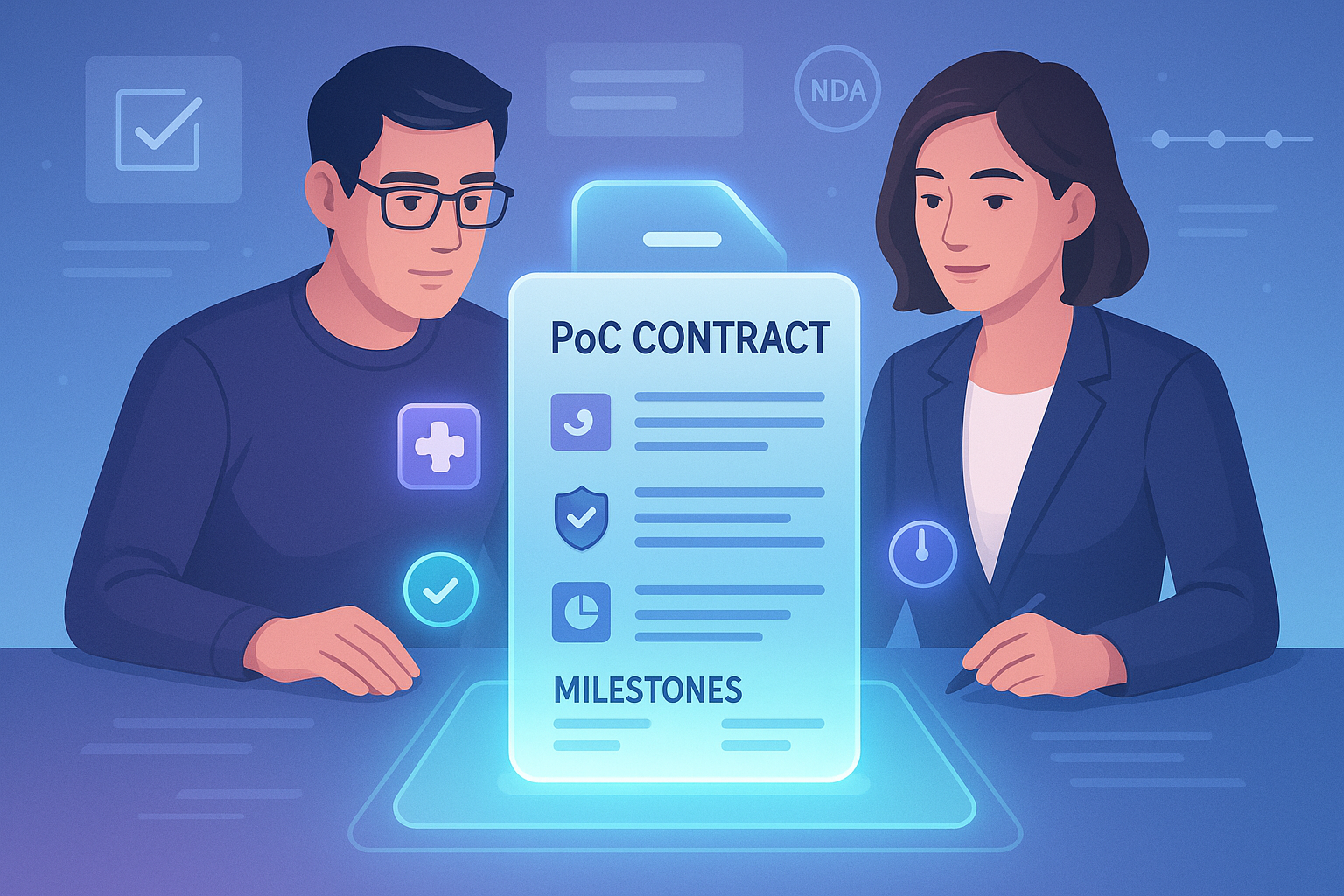
Your PoC contract isn’t a formality — it’s the first layer of your product’s foundation. When it’s thoughtful, detailed, and aligned with business needs, it sets up everything else for success: delivery, decision-making, budgeting, and trust.
So the next time you start a PoC, don’t just ask, “When can we start coding?” Ask,
“What does a successful contract look like?”
Chances are, it’ll look a lot like the ones we build here at Trembit. Contact us!