In the highly dynamic environment of finance, liquidity is a predominant concern among all stakeholders. It determines the capacity of individuals to receive housing, education, and transportation, as well as the potential to start, develop, and expand business for entrepreneurs. The relationship between the process of borrowing and lending is accompanied by numerous uncertainties, which arguably affects both lenders and potential borrowers. On one hand, financial institutions require comprehensive information to gauge the creditworthiness of an applicant. On the other hand, applicants operate in a non-transparent system, where they do not have an exhaustive understanding of the criteria for approval. Hence, this makes it challenging to enhance the credit capacity for potential applicants. The introduction of AI in credit scoring is transforming this landscape by providing more precise and comprehensive evaluations, thereby reducing uncertainties and improving the transparency of the credit assessment process.
In such a situation, the emergence of AI-based credit scoring is a radical development in the field. AI enables lenders to have a more informed judgment and be more nuanced when assessing the credit capacity of an applicant. Unlike the traditional approach, AI processes and integrates different forms and sources of information, such as online transactions and the behavior of a borrower in various situations. This allows the algorithms of AI to identify hidden patterns and potential correlations, which the human mind would not be capable of discerning. As reported by Polaris Market Research, the global credit scoring services market will reach USD 155.81 billion by 2032, boosting the compound annual growth rate to 24.06%.
The core purpose of this article is a detailed analysis of AI-based credit scoring. It will explore the mechanisms, advantages, disadvantages, and real-life applications of the concept.
Decoding Credit Scoring Concept And its Metrics
Credit scoring refers to the practice of evaluating a prospective borrower’s creditworthiness, or ability to pay back a loan, in a systematic and comprehensive manner. In this way, lenders are able to measure the likelihood that the borrower will repay the loan in a responsible and punctual fashion. There are various aspects on which the concept of credit scoring is based on. Key elements include:
Quantitative Aspects
- Income: Wage and other sources of income are one of the main aspects that reflect the financial capabilities of the borrower. Lenders evaluate to confirm that one has regular revenue which can pay for the forthcoming obligations. Salary bracket is proportional to the risk involved in the credit. The higher the earnings one makes, the less risky the credit will entrust.
- Monthly Outlays: Understanding how much one spends per thirty days is used to find out the balance of the loan service. Outlays include accommodation expenditures, including rent and mortgage, utilities, assurance, debts, or any payment made frequently.
- Cash Flow Evaluation: It is vital in businesses. The monitoring of the eventualities of source of cash for business, plus its outflow evaluation, determines the reliability of the industry in need of a loan.
Qualitative Aspects
- Relationship Status: This can play a role in financial stability, as households with two incomes may exhibit greater financial resilience than those with a single earner.
- Educational Background: While not universally used, some lenders may factor in an individual’s level of education, which can correlate with earning potential and financial acumen.
- Employment Nature: The type of job in terms of how secure and stable the job is considered. Permanent jobs are favored over temporal occupations.
- Business Structure: (for companies): In the case of business borrowers, the legal framework they operate under (e.g., sole proprietorship, limited liability company, corporation) can impact their creditworthiness. Each business structure carries its own implications for liability and financial robustness.
- Industry Sector: The sector in which a business operates can impact its credit risk, with some industries being more resilient to economic downturns than others, affecting a lender’s risk assessment.
- Accounts Upkeeping Ways: Lenders may evaluate how well a business maintains its financial records and transparency in reporting, which can build trust and confidence.
It is important to note that the listed elements and their weighting can indeed differ between lenders and credit scoring systems. Hinging on the lender’s risk appetite, and lending policies, some elements may take a higher priority over others. Similarly, company risk assessment strategies sometimes also play an important role.
However, customer behaviors are not less of an important aspect that can hurt credit scoring. They include:
Payment Track Record
This is probably the most important element in terms of credit scoring. In short, your record shows how responsible you are in terms of various types of loans and credits. The clean and ownership record without public records of lawsuits, liens, or bankruptcy is good for you. If you were late for a payment, its level of lateness will determine how much of a negative impact it will have on your credit score.
Credit Utilization
This element shows what percentage of your available credits you use at the moment. It means you need to maintain your credit card balance at under 30% of the credit limit – this is considered good by most credit scoring models.
Credit History Length
This is how long you have your credit account. The longer, the better, as scoring models consider it an indicator of your ability to manage your credits.
Credit Variety
It refers to the types of credit available to you and how well you manage them. If you handle credit card bills, mortgage or rent, auto loan, and utilities bills well, you have a varied credit history and it will play in your favor.
New credit
Your new credit rating shows how often you apply for a new credit card or loan. If you applied for several new credits, credit scoring models may interpret it as preparation to use them. Applying for a credit for buying a car and a new credit card will be considered differently by scoring models because the former indicates that you were preparing to buy a car, while the latter may indicate unplanned use of your existing credits.
Understanding AI in Credit Scoring
First and foremost, contemporary credit scoring methods use AI that changes the concept of assessing a borrower’s creditworthiness. Unlike the fixed parameters and past indications of traditional models, AI’s machine learning algorithms analyze an incredible amount of data from various sources. Its purpose is to provide an accurate forecast regarding the likelihood that an applicant will repay the loan. Accordingly, lenders can obtain full information about the actual financial habits of the borrower and determine the precise nature of the credit risk. A credit scoring algorithm is considered by credit bureaus and lenders when making any credit decision; it assesses the borrower’s likelihood of default on a bank’s obligations.
The model takes into account several parameters or pieces of information, such as payment history, credit account balances, credit history, types of credit accounts, and credit searches. The last ten searches are analyzed, which is important for the lender since the applicant may urgently need money from his account. The impact of each item on the credit score depends on the proposed formula.
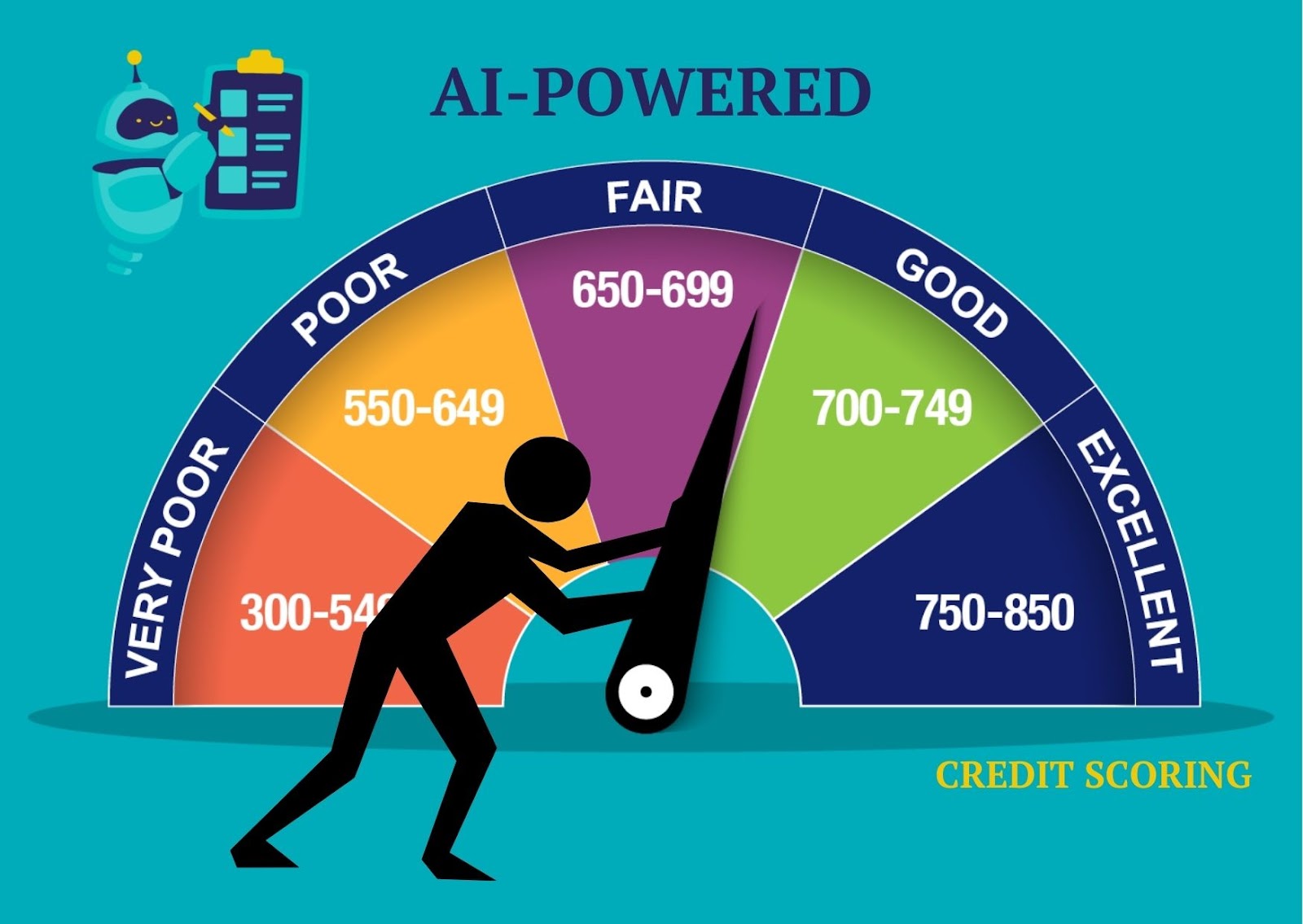
Usually, scores are determined in the range of 300-850 points, with higher scores meaning less chance of default and credit risk. Lenders track average values to make decisions and develop specific requirements for potential borrowers. A high score generally means more convincing terms of the credit offer. Alternatively, the lower the estimated value, the less favorable the facilities. The rate usually increases, and the borrowing period and the amount of the loan decrease.
How AI-Credit Scores Work From the Inside?

Credit scoring systems powered by artificial intelligence utilize intricate machine learning algorithms to evaluate the creditworthiness of borrowers. These algorithms undergo training on vast historical datasets containing insights into borrowers’ financial behaviors and their repayment track records. Essentially, the machine learning model examines the historical data it was trained on to detect patterns and relationships that indicate whether the borrower possesses the capacity to repay a loan and interest. In this regard, the process can be broken down into several stages:
- Data Aggregation
AI-driven credit scoring systems collect data from different sources. Traditional credit data is based on payment history, the sum of outstanding debts, the duration of credit history, and other data about repayments. However, AI-powered models differ in that they incorporate alternative data as well, providing a more comprehensive view of a borrower’s financial performance. This data includes
- Transactional data – financial details about income, spending, and general financial habits.
- Online data – borrowing-related information gleaned from an applicant’s online activities, including search history, website visits, and purchases.
- Social media data – credit scoring systems look at the applicant’s posts, interactions, and friends to determine their lifestyle and social network.
- Data Processing and Feature Selection
The collected data is processed, and features in the form of variables are selected for the predictive model to use. This part of the process is extremely important as the accuracy of the predictive model depends on the selection.
- Model Training
Machine learning algorithms use the preprocessed and engineered dataset to actually learn. As the dataset used is historical, the model detects complex patterns and dependencies within the data. Simultaneously, the model determines which features have the greatest impact on the prediction of creditworthiness and how they all interact.
- Prediction
After the training, the model can make predictions on new data. This means that when the borrower applies for the loan, the credit scoring system uses their details to evaluate the risk of lending to them and what are the chances the loan will be repaid. These predictions are always based on the patterns and relationships the algorithm obtained from the historical data.
The use of AI-based credit scoring systems allow for a more holistic assessment of credit risk since the model takes into account a larger number of data sources. This means that the traditional methods of credit assessment rely heavily on credit data, and sometimes may fail to evaluate the borrower based on their actual financial performance. AI-based models, however, use both sources of information, providing a well-rounded view of the individual.
Nevertheless, questions of fairness, transparency, and privacy come with the implementation of AI-based systems and should be addressed to ensure the process is unbiased and ethical.
What Are the Ways AI Improves Risk Assessment in Credit Scoring?
There are familiar conventional scorecard processes in many financial institutions. In general, they practically did not change from the moment of creation. Approximately all of them are linked by one rule: in order to be able to score a potential borrower, a sufficient track record of past borrowing is necessary. However, for newbies in the banking field, obtaining loans is not an easy task. They have all the moral, but not pragmatic right to credit. At the same time, they do not have historical debt data required for credit scoring.
AI scoring is focused on the present and future prospects, rather than the past or present. It includes the consideration of present income, employment opportunities, future income growth, and other variables. People with dubious qualifications with bright prospects are often easier to repay with loans, and vice versa, seemingly honest citizens who do not churn out credit cards and maintain different loans simultaneously are not given credit. The use of AI scoring allows for more precise and correct predictions. You may be sure that this is true because this system is based on intelligent AI models, which cover a broader spectrum of real-time indicators for more accurate forecasting.
Varieties of Credit Scoring Models
Credit scoring models are commonly divided into statistical and judgmental categories, each employing distinct methodologies to evaluate an individual’s creditworthiness.
- Statistical Scoring Model: Statistical scoring models adopt a data-centric approach, analyzing diverse factors obtained from credit reporting agencies. These factors encompass payment histories, credit utilization patterns, credit history lengths, types of credit accounts, and recent credit inquiries. The model then scrutinizes and correlates these factors, assigning weights based on their influence on creditworthiness. This process is entirely objective, uninfluenced by subjective judgments or experiences of credit assessors. The resultant credit score serves as a numerical representation of an individual’s credit risk, derived from statistical analysis of their financial conduct.
- Judgmental Scoring Model: In contrast, judgmental scoring models take a more subjective route, combining objective financial data with subjective evaluations. These models incorporate financial statements from individuals or organizations, payment histories, bank references, and subjective assessments made by human underwriters in decision-making. This approach allows for a more personalized assessment, considering not only financial data but also the context and circumstances surrounding an applicant’s credit history.
While statistical scoring models rely on statistical analyses of quantifiable data, judgmental scoring models integrate personal assessments and experiences into credit score determination. Both models possess their own advantages and are deployed based on the specific requirements and preferences of lending institutions or organizations.
Conventional vs. Innovative Credit Scoring Models
Traditionally, the basis of most credit scoring systems heavily relied on historical payment records and was constructed using statistical methodologies such as linear regression, decision trees, logit modeling, among others. These conventional models were limited in their use of structured data for evaluating credit risk.
- Linear regression:
Within regression-based credit scoring models, the objective revolves around forecasting and interpreting credit risk and default likelihood. This entails scrutinizing structured data, with a focus on the desired outcome (e.g., default/non-default). The structured data comprises diverse independent variables or factors pertaining to an individual’s credit history, financial status, and pertinent details.
The process involves identifying the optimal parameters that minimize disparities between the anticipated credit risk (based on these independent variables) and the observed credit risk. This is achieved through regression analysis, a statistical technique that identifies correlations between the desired outcome and the independent variables.
The regression model aims to formulate a mathematical equation representing this correlation. For instance, as an individual’s debt escalates, their likelihood of default also rises. Parameters are fine-tuned to generate the most precise prediction of credit risk based on the provided data.
This methodology enables lenders and financial institutions to gain valuable insights into the factors influencing credit risk. Such understanding aids in making well-informed decisions regarding extending credit to applicants and the associated terms, facilitating the assessment of potential loan risks.
- Discriminant analysis:
Discriminant models offer objective means of distinguishing between desirable and undesirable customers. By employing discriminant analysis, lending entities can differentiate between favorable and unfavorable credit customers. Lenders often seek methods to identify undesirable customers using data extracted from customer financial statements. Thus, employing straightforward discriminant analysis significantly contributes to offering reliable solutions for lenders.
Each customer is assigned a composite score. Lenders can then establish a minimum score to differentiate between desirable and undesirable customers. Unlike the simpler model considering only two factors, the advanced discriminant analysis approach incorporates numerous factors influencing credit scores. These factors interact, and the model assigns suitable weights to each factor, creating a more comprehensive credit scoring framework.
Two contemporary credit scoring models are:
- Deep neural networks: These models learn to identify data patterns through iterative processing across multiple layers, departing from predefined equations. They adapt and refine their comprehension by assimilating outputs from prior layers, enabling the detection of intricate, nonlinear patterns in unstructured data.
- Clustering: This credit scoring method categorizes data into distinct clusters showcasing notable distinctions. For instance, a clustering algorithm might create a dedicated cluster for borrowers whose creditworthiness is challenging to evaluate accurately. Once identified, this cluster’s average default rate or assessment can serve as a benchmark for estimating the default probability for individual borrowers within the same cluster. Leveraging similarities within clusters facilitates more accurate credit risk assessments for borrowers with analogous characteristics, making it a valuable tool for lenders in evaluating creditworthiness.
While the traditional models for assessing credit mainly rely on structured data and statistical methods, AI models leverage various sources of data and more sophisticated algorithms, for offering a complete and more accurate evaluation of the credit. For instance, deep neural networks and clustering have completely transformed credit scoring systems, allowing companies to use unstructured data and detect even the smallest patterns. As a result, a higher number of people from all walks of life have access to credit.
Applications of AI-Powered Credit Scoring

Credit scoring mechanisms serve as vital instruments for lenders to evaluate the financial standing of individuals or businesses seeking credit. These models integrate diverse factors and data to prognosticate the probability of borrowers meeting their repayment obligations. The utility of AI-based credit scoring spans various sectors and plays a pivotal role in:
Precision Loan Interest Calculation
AI-infused credit scoring models refine the accuracy of computing loan interest rates through the utilization of machine learning algorithms and an extensive array of data inputs. These algorithms meticulously scrutinize a borrower’s financial background, payment trends, and other pertinent variables, culminating in a more dynamic and comprehensive evaluation compared to conventional methodologies.
In the AI-centric paradigm, sophisticated models dissect and analyze copious data sets, unearthing patterns and insights that might evade conventional observation. Consequently, the assessment of a borrower’s creditworthiness becomes more nuanced and precise.
For borrowers, this translates into personalized interest rates derived from an exhaustive AI-driven scrutiny of their credit risk. Individuals showcasing prudent financial conduct and boasting a robust credit history, as evaluated by the AI, are poised to benefit from reduced interest rates owing to a diminished perceived risk of default. Conversely, borrowers deemed to pose a higher credit risk, as gauged by the AI model, might contend with elevated interest rates to mitigate the lender’s risk, thereby incentivizing borrowers to uphold responsible financial practices.
Credit Card Approvals and Limit Determination
Credit card issuers increasingly leverage AI-based credit scoring models to assess the financial reliability of applicants. These models consider an array of factors, including credit history, income, debt, and other relevant financial behaviors, transcending conventional credit scores. The outputs of these AI-driven models substantially influence decisions pertaining to credit limits, interest rates, and credit card terms, ensuring alignment with the applicant’s risk profile.
In delineating credit limits, AI-based credit scoring harnesses machine learning algorithms to conduct an exhaustive and adaptable analysis. This entails scrutinizing an individual’s payment history, transactional patterns, and other salient financial data. For applicants boasting superior credit scores, AI’s in-depth analysis, coupled with a comprehensive dataset, may result in higher credit limits, indicative of a nuanced understanding of their lower-risk attributes. Conversely, for individuals with lower credit scores, AI’s assessment may suggest more conservative credit limits, commensurate with a perceived heightened risk of default.
This AI-augmented approach fosters a more nuanced and data-rich evaluation, facilitating credit limits that more accurately reflect an individual’s genuine creditworthiness and financial capability. Such a process aids issuers in managing risk effectively while furnishing suitable credit card options to a diverse consumer base.
Business Loan Approval
AI assumes a transformative role in augmenting traditional credit scoring paradigms when evaluating businesses seeking loans. Through machine learning algorithms, AI conducts intricate analyses of extensive datasets, extracting insights from non-traditional and dynamic variables to holistically assess a business’s creditworthiness. It facilitates real-time assessment, adaptive learning, and enhanced predictive accuracy, equipping lenders with enriched information to render loan approval decisions and delineate specific loan terms.
Insurance Premium Determination
In the insurance realm, AI-based credit scoring models transcend mere credit histories to appraise an individual’s or entity’s financial accountability. By scrutinizing extensive data, AI can furnish a more nuanced prognosis of payment reliability and overall risk, aiding insurance companies such as home insurers in setting premiums congruent with the individual’s actual risk level.
Risk Management and Portfolio Analysis
AI-driven credit scoring models usher in advanced analytics into risk management and portfolio analysis. They process voluminous data sets at high velocities, facilitating financial institutions in rendering quicker and more precise evaluations of risk exposures in their lending portfolios. AI’s predictive capabilities enable more proactive and strategic decision-making concerning diversification, risk mitigation, and capital allocation.
Financial Planning and Counseling with AI
Financial advisors leveraging AI-based credit scoring models can dispense more tailored and proactive counsel. AI can unveil deeper insights into clients’ financial proclivities and trends, facilitating more precise guidance on augmenting credit scores and overall financial well-being. Through AI, advisors can proffer strategies more aligned with an individual’s unique financial circumstances and aspirations, heightening the efficacy of financial planning and counseling.
Conventional Credit Scoring vs. AI-Powered Credit Scoring
| Aspect | Traditional Credit Scoring | AI-Based Credit Scoring |
| Data Analysis Method | Mainly relies on structured credit data and predefined regulations | Utilizes machine learning algorithms for intricate pattern recognition and predictive modeling |
| Data Considered | Limited scope, potentially overlooking numerous factors | Incorporates alternative data sources for comprehensive evaluations |
| Decision Making | Easy to explain and interpret due to clear rules and factors | Employs sophisticated algorithms that continually learn and adapt |
| Processing Speed | Longer processing times and potential delays | Provides faster and more efficient credit assessments |
| Handling of Missing Data | Struggles with missing data, possibly leading to inaccurate evaluations | Manages missing data more effectively through imputation techniques and feature engineering |
| Bias and Fairness | Subject to human judgment, which may result in discrimination and biases | Minimal biases as decisions are made solely based on relevant factors by AI algorithms |
| Model Accuracy and Predictiveness | Generally less accurate due to simplicity and limited data sources | Potential for higher accuracy due to advanced algorithms and access to diverse data types, leading to more precise credit risk assessments |
| Reviews | May necessitate manual review for borderline cases or individuals with limited credit histories | Capable of automated decisions for a wider range of individuals, potentially reducing the need for manual reviews |
It is crucial to note that traditional and AI-based credit scoring models have different advantages and disadvantages. The choice between them depends on factors, such as data availability, legislative needs, and desired predictive accuracy, matching specific requirements of a certain lending organization.
Advantages of AI-driven Credit Assessment
AI-based credit scoring procedures offer a number of advantages over traditional systems, all of which improve the accuracy and overall quality of assessing a person’s or company’s creditworthiness. In this section, the benefits of AI in credit scoring are considered in-depth:
Greater Precision: the algorithms can analyze more data from different sources; the broader range of factors considered allows for a better assessment of credit risk. The models can, therefore, identify more subtle patterns and correlations that are undetected by humans. As a result, fewer applicants will be incorrectly rejected or approved.
Faster Decision-Making: AI algorithms can process data much quicker than manual processing. Thus, the decision is made within mere seconds following the review of the loan application. It benefits all parties involved, as applicants do not need to wait long, and lenders receive results quicker. This is especially important in online and peer-to-peer lending, where fast decisions must be made frequently to stay competitive.
More Accurate Risk Segmentation: Using AI, the borrowers can be divided into more subtle risk groups. This improvement allows offering better loan conditions and interest rates to all sides of the deal.
Absence of Human Bias: the older credit scoring models may include bias over race and gender. AI, however, can be geared to avoid such bias and to consider only financial parameters. Thus, the use of AI leads to more equitable and fair lending practices. It remains also to note that a standardized approach to the issue is easier in terms of compliance with legal requirements.
Scalability: AI credit scoring models are very scalable, and are equally good for 10 and 10 000 applications per day. They can analyze any number of datasets without reducing the quality of their work.
Cost-Efficiency: AI credit scoring significantly reduces operation costs due to their automation. Lenders no longer need to maintain separate departments of staff engaged in risk determination and can exempt the staff who were collecting and processing the data as well. Loans can also be issued more quickly, which results in the saving of additional funds. Operating costs can become up to 70% lower when banks and financial institutions utilize AI credit scoring.
Fraud Detection: the algorithms can, therefore, detect fraud based on KPIs through historical data analysis. Theft, loan stacking, and other fraud can be detected and prevented.
Financial Inclusivity: AI does not rely on common banking source data and can analyze different information because of it. Hence, the groups of people that have low credit histories or non-consistent bank records can be welcomed. It, in turn, refers to developing markets and small businesses which often experience difficulties when applying for a loan.
Compliance: all models are, therefore, compliant with different regulations and naturally produce reasons for the decision.
Reduced Errors: AI scoring is less vulnerable to human-based errors influencing the wrong decision and, accurately processing data, introduces a smaller margin for operative mistake.
Trembit’s AI Revolution in Credit Analysis and Document Processing
Trembit has introduced an AI-Powered Intelligent Document Processing (IDP) solution, specifically tailored for the credit industry, which marks a significant advancement in optimizing financial assessments. This system is a game-changer for credit companies, particularly in the vehicle and machinery lease financing sector, as it streamlines the credit evaluation process through the innovative use of AI technologies.
At the heart of Trembit’s offering is the ability to efficiently manage and process a vast array of credit-related documents. By employing advanced AI algorithms, the IDP system meticulously extracts, analyzes, and interprets data from various documents. It enhances this process by integrating information from open databases, thus providing a comprehensive assessment of credit risks. This integration allows for a thorough insight of credit histories, leading to more accurate and reliable credit risk evaluations.
The technological foundation of Trembit’s solution includes the Abacus Smaug 34B LLM, which powers the AI’s analytical capabilities, allowing for deep insight extraction from complex financial documents. The LangChain technology facilitates seamless integration of AI components, ensuring smooth and coherent processing workflows. Essential tools like Python and OCR libraries are instrumental in the initial stages of document processing, particularly for text extraction, while Node.js provides a robust and scalable framework for the application’s architecture.
Trembit’s AI-powered IDP solution is highly flexible, capable of adapting to the unique requirements and needs of both small credit companies and large corporations. These entities often need to handle large volumes of data and complex workflows, and Trembit’s solution is designed to accommodate these demands effectively.
By pioneering in financial technology innovations, Trembit is setting new benchmarks in document processing and risk assessment in the credit industry. The AI-driven platform not only simplifies the handling of documents but also augments the decision-making process, enabling credit analysts to make swift and informed decisions. This results in elevated efficiency of credit assessments and enhances the overall precision in decision-making.
Closing Thoughts
One of the most significant advancements in the financial sector appears to be the integration of artificial intelligence into credit scoring systems. AI’s enhanced analytics capacity and unprecedented ability to handle vast sets of data excel that which can be achieved through traditional methods. AI introduces previously unseen levels of accuracy and complexity into this approach, creating scores that are significantly more comprehensive than their traditional counterparts.
Overall, the use of AI scoring sheds light on a far more accurate, all-embracing, and adaptable approach to creditworthiness assessment, making algorithms evolve and improve by adjusting to the shifts in financing behaviors and patterns that individuals demonstrate. Therefore, unprecedented insight into individuals’ financial situations and, therefore, opportunities for accurate and unbiased evaluation of their creditworthiness are created, allowing for an even more comprehensive and applicable approach to financing for different demographics of the population.
Taking into account the advancements introduced in the realm of credit scoring by AI, it is obvious that the technology is being redefined as a driving force in the development of the target discipline. The dawn of the age of high intelligence and an in-depth approach to the understanding of individuals’ financial situations, the journey of progress is far from over, and the number of opportunities awaiting is boundless. At Trembit, we specialize in developing AI and Machine Learning Solutions that enhance precision and efficiency in financial risk analysis. Our expertise ensures that businesses can leverage cutting-edge technology to stay ahead in the competitive financial landscape.