Over the past decade, the creator economy has transformed from a niche corner of the internet into a multi-billion-dollar industry. YouTube stars, Twitch streamers, TikTok influencers, and independent podcasters are no longer just entertainers — they are small business owners, building personal brands with audiences that rival those of traditional media outlets.
But this growth has brought new challenges. Platforms must protect their communities from harmful content, personalize user experiences to keep audiences engaged, and unlock innovative monetization models to keep creators financially motivated, all while doing so.
In this high-speed environment, manual solutions can’t keep up. The key enabler? Artificial Intelligence which is quietly powering the workflows, insights, and revenue models behind the most successful creator platforms.
In this article, we’ll walk through how AI is transforming every stage of the creator platform lifecycle, from moderation to personalization to monetization, with research data, examples, and practical steps for implementation.
From Option to Necessity: AI’s Role in Modern Creator Platforms
The days of relying on human moderators, static content feeds, and one-size-fits-all monetization models are gone. The scale and speed of modern platforms demand automation, adaptability, and precision — qualities that AI naturally delivers.
According to a 2024 McKinsey report, over 70% of platform owners plan to make AI a core driver of growth between 2025 and 2026. It isn’t simply about improving efficiency—it’s about ensuring survival in an increasingly competitive market. Without AI, platforms risk being outpaced by rivals that deliver faster, safer, and more engaging user experiences.
The need becomes clear when you look at the three pressure points affecting all creator platforms today:
| Challenge | Impact Without AI | AI-Powered Solution |
| Content Scale | Manual review teams can’t keep pace with uploads. | Real-time automated moderation with NLP + computer vision. |
| Audience Expectations | Generic feeds fail to retain users. | Personalization algorithms based on behavioral data. |
| Monetization Pressure | Ad revenue models are volatile. | AI-driven dynamic pricing, microtransactions, and upsell targeting. |
These areas don’t operate in isolation — failing in one can weaken the others. When moderation is weak, user trust erodes. As trust declines, people spend less time on the platform, and lower retention inevitably leads to shrinking revenue potential. AI offers a way to strengthen all three pillars simultaneously.
AI in Action: From Moderation to Monetization
The most successful creator platforms don’t treat moderation, personalization, and monetization as separate departments. Instead, they weave AI into a continuous cycle where each stage feeds the next. Let’s unpack what that looks like in practice.
AI in Practice: Linking Moderation, Personalization, and Monetization
Content moderation is often seen as a defensive tactic — a way to stay compliant with regulations and avoid PR crises. In reality, it’s the bedrock of long-term growth. A community where users feel safe and respected becomes far more engaged, attracting both creators and advertisers.
Take YouTube as an example. Its machine learning classifiers proactively detect and remove millions of harmful videos before they’re even viewed. Similarly, TikTok’s AI moderation system reviews and processes over 90% of flagged content within 24 hours, freeing human moderators to handle only the most complex or borderline cases.
Technically, this involves:
- Natural Language Processing (NLP) to catch harassment, hate speech, and misinformation in comments or captions.
- Computer Vision to identify explicit or restricted imagery.
- Context-aware models capable of distinguishing between harmful and permissible uses of certain words or visuals (e.g., educational vs. explicit content).
By embedding AI moderation early, platforms not only reduce operational costs but also build the trust that powers everything else — from recommendations to monetization. After all, no brand wants to advertise alongside harmful content, and no user wants to scroll through an unsafe feed.
Context-Aware Feeds That Anticipate User NeedsRevenue
Once harmful content is filtered out, the next challenge is keeping users deeply engaged. In the age of infinite content, attention is the most valuable currency — and personalization is the best way to earn it.
AI recommendation systems don’t just show what’s popular; they learn individual preferences and surface the most relevant content at the right time. This is the secret behind TikTok’s addictive For You page and Twitch’s ability to match viewers with streamers they’ve never seen before.
The personalization landscape is evolving in 2025, with platforms embracing:
- Hybrid Recommendation Models combine collaborative filtering (what similar users liked) with content-based filtering (what matches your past preferences).
- Real-Time Contextual Adjustments—feeds that adapt based on time of day, location, and device type.
- Predictive Engagement Scoring to estimate which content you’re most likely to watch, comment on, or share next.
TikTok’s leaked internal data in 2024 showed that its personalization algorithms boost daily active user sessions by 67%compared to static trending feeds. For platform owners, that’s not just engagement—it’s a multiplier effect on monetization opportunities.
Monetization Models that Evolve in Real Time: Turning AI Insights into Revenue Growth
With trust established and engagement optimized, the final stage is turning those interactions into revenue — for both creators and the platform.
Historically, monetization meant ads, subscriptions, or basic tipping. But AI enables more dynamic, context-sensitive revenue models that can adapt to user behavior in real time.
| AI Monetization Model | How It Works | Example |
| Dynamic Pricing | Adjusts prices based on demand, scarcity, or user profile. | Patreon adjusting membership tiers during creator growth spikes. |
| Smart Merchandising | Suggests products, digital goods, or courses tailored to viewer interests. | Twitch promoting merch mid-stream during peak engagement moments. |
| Engagement-Based Payouts | Rewards creators based on quality of engagement, not just views. | TikTok Creator Fund 2.0’s engagement-weighted model. |
| AI-Ad Placement | Places native ads at points of highest attention without breaking immersion. | YouTube inserting sponsor messages at peak retention moments. |
Industry analysts predict that AI-powered monetization tools — such as dynamic pricing, targeted product recommendations, and engagement-based payouts — could significantly boost average creator earnings over the next three years, as platforms adopt more personalized and data-driven revenue strategies.
The Integrated AI Creator Platform Model
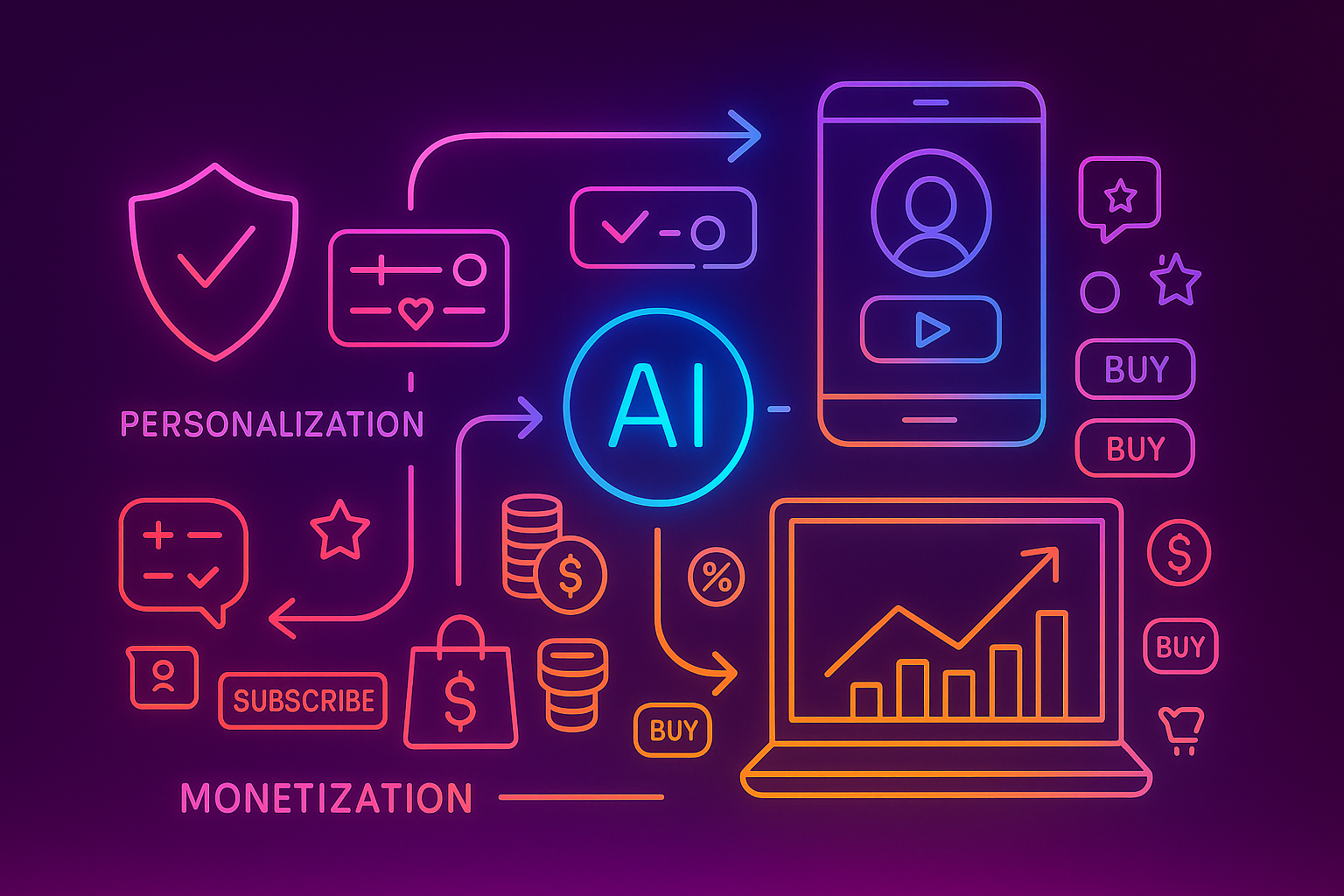
When AI moderation, personalization, and monetization work in harmony, the result is a self-reinforcing growth loop:
- Moderation AI ensures content safety, making the platform attractive to users and advertisers.
- Personalization AI increases session time and user loyalty.
- Monetization AI turns higher engagement into targeted, higher-value transactions.
It isn’t a linear pipeline — it’s a cycle. Higher monetization opportunities draw more creators to the platform, expanding the variety of content. This broader content mix enables better personalization, which drives greater user engagement — ultimately creating even more monetization potential.
Step-by-Step AI Implementation Roadmap for Platforms
For platform builders and decision-makers, here’s a phased approach to embedding AI capabilities:
- Phase 1: Build the AI Moderation Core
- Start with off-the-shelf NLP and computer vision APIs to handle the bulk of review tasks.
- Fine-tune models with domain-specific datasets for accuracy.
- Phase 2: Add the Personalization Layer
- Deploy hybrid recommendation systems.
- Integrate real-time feedback loops to refine results continuously.
- Phase 3: Launch the AI Monetization Engine
- Test dynamic pricing strategies.
- Automate merch and ad placements using behavioral triggers.
- Phase 4: Continuous Optimization
- Run A/B tests to measure the impact of AI changes.
- Incorporate user and creator feedback into model retraining.
Final Takeaway for Trembit Customers
At Trembit, we’ve seen that AI is no longer a nice-to-have — it’s the strategic backbone of next-generation creator platforms. Those who integrate AI thoughtfully — from moderation to monetization—are building ecosystems where creators thrive, users stay engaged, and revenue grows sustainably.
The platforms that win in this new era won’t just use AI as a tool; they’ll treat it as an architectural principle, designing every workflow, interaction, and business model around intelligent, data-driven automation.