
AI Orchestration — Make Your AI Reliable in Production, Not Just in the Demo.
Anyone can call an LLM API. Few can build the orchestration layer that makes a multi-model, multi-agent AI system reliable, observable, affordable, and compliant under real load — routing, fallback, RAG, guardrails, and cost control, engineered between your app and its models.
Trusted by Teams Whose Products Depend on AI





Sound Familiar?
Your AI works with one model and one prompt — and falls apart in production.
The demo was flawless. Then real users sent real inputs, the model hallucinated, latency spiked, and edge cases you never scripted started breaking things. A prompt is not a production system. Orchestration is the layer that turns a working prototype into something you can put in front of customers.
When a model is down or rate-limited, your whole feature goes down with it.
No fallback, no retry, no secondary provider. A single 429 or an OpenAI outage takes your product offline. Production AI needs routing and graceful degradation — the same discipline you’d demand of any critical dependency.
Your token bill is ballooning and nobody can explain why.
Every request hits your most expensive model. There’s no caching, no cheaper model for easy queries, no budget ceiling. Costs scale with usage instead of value, and finance is asking questions you can’t answer.
You can't see or trace what the AI actually did.
When an answer is wrong, you can’t replay the request — which model ran, what context it retrieved, which tool it called, what it cost. Without observability, every bug is a guess and every incident is a mystery.
Your multi-step and multi-agent workflows break silently.
One agent hands off to another, a tool call fails, and the chain keeps going with bad state. No one notices until a customer does. Coordinating multiple models, agents, and tools reliably is an orchestration problem, not a prompting one.
You have no guardrails, no evals, and you're locked to one vendor.
Nothing checks outputs for safety, format, or accuracy before they reach users. You have no way to measure whether a prompt or model change made things better or worse. And your whole stack is welded to one API — so when pricing changes or a better model ships, you can’t move.
What an AI Orchestration Layer Actually Does
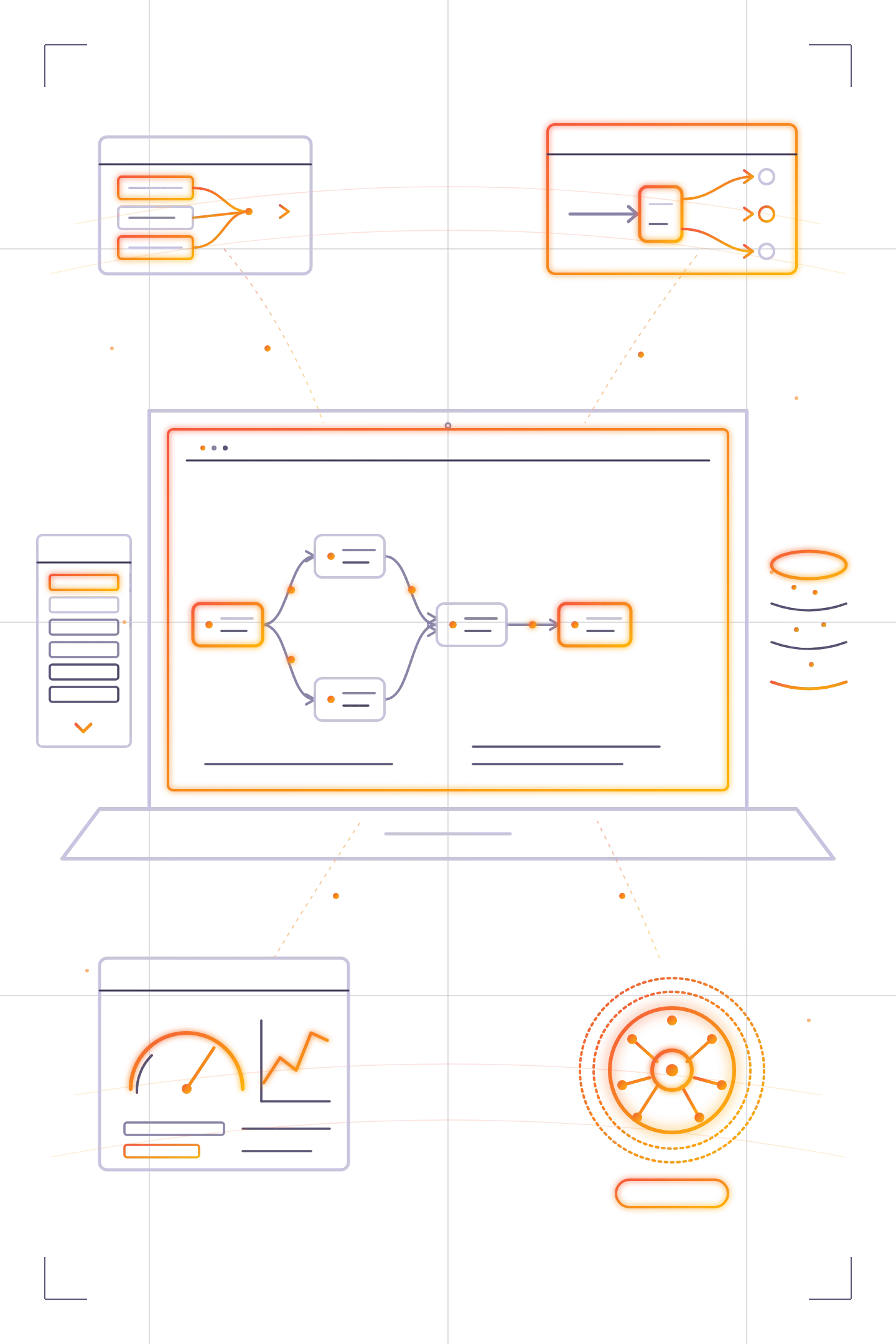
An AI orchestration engine is the production layer that sits between your app and its models. It routes each request to the right model, handles fallback and retries when one fails, manages the RAG and context pipeline, coordinates multi-step and multi-agent workflows, enforces guardrails and evals on inputs and outputs, caches to cut cost, and gives you observability plus cost control across the whole system. Most teams can call an LLM. The orchestration layer is what makes that call reliable, traceable, affordable, and compliant at scale — and it’s the difference between an AI demo and an AI product.
AI Orchestration Services
Orchestration Engine Design
For teams turning a working prototype into a production AI system.
We design and build the core orchestration engine — model routing by task, cost, and latency; automatic fallback to a secondary model or provider when the primary fails or rate-limits; retries with backoff; and semantic caching to cut both cost and response time. You get a layer that keeps serving even when an individual model doesn’t.
- Model-routing policy (task to model, with cost and latency targets)
- Fallback and retry logic across providers, with graceful degradation
- Semantic and response caching to cut token spend
- A single, model-agnostic API your app calls instead of raw provider SDKs
Multi-Agent Orchestration & Tool Use
For teams building agentic workflows that coordinate models, tools, and steps.
We orchestrate multi-agent and multi-step systems — planning, delegation between agents, tool and function calling, and state management across a chain — with the error handling that keeps a broken step from poisoning the rest of the workflow. The agents run on this layer.
- Agent coordination and hand-off logic with explicit state
- Tool / function-calling integration and safe execution
- Step-level error handling, timeouts, and recovery
- Deterministic replay and tracing across the whole chain
RAG & Context / Data Pipelines
For teams grounding AI in their own data.
We build the retrieval and context layer — ingestion, chunking, embeddings, vector search, re-ranking, and dynamic context injection — so the model answers from your data instead of guessing. This is where orchestration meets your existing systems, and it’s often an integration problem as much as an AI one.
- Ingestion and embedding pipeline with a chosen vector store
- Retrieval, re-ranking, and dynamic context-injection logic
- Freshness / re-index strategy for changing source data
- Grounding and citation handling to reduce hallucination
LLMOps — Evals, Guardrails, Observability & Cost Control
For teams that need to trust, measure, and afford their AI over time.
We instrument the whole system — input/output guardrails, an eval harness to catch regressions before they ship, full request tracing, and per-request and per-model cost tracking with budget ceilings. You get the operational visibility to run AI like any other production dependency.
- Guardrails on inputs and outputs (safety, format, PII, policy)
- Eval harness to score prompt and model changes before release
- End-to-end tracing: model, context, tools, latency, and cost per request
- Cost dashboards, budget ceilings, and alerting
How Our Orchestration Layer Works
Request In
Your app calls one model-agnostic API — not a raw provider SDK — so the orchestration logic lives in one place, not scattered across your codebase.
Routing
The engine picks the right model for the task by capability, cost, and latency target — and knows which provider to fall back to if the first is down or rate-limited.
Context & RAG
Relevant data is retrieved, re-ranked, and injected as context, so the model answers from your knowledge, not its training cutoff.
Tool & Agent Calls
For multi-step work, the engine coordinates tool calls and agent hand-offs, managing state and handling any step that fails.
Guardrails & Eval
Inputs and outputs pass through safety, format, and policy checks before anything reaches a user; evals catch regressions before release.
Response Out
The validated answer returns — with fallback already handled if any step failed, so the user gets a graceful result instead of an error.
Observability & Cost
Every request is traced end to end — model, context, tools, latency, and cost — so you can replay any interaction and see exactly where the money went.
Industries We Serve
Healthcare & Telemedicine
Clinical AI where a wrong or unlogged answer is a liability. We build orchestration with guardrails, audit trails, and data residency designed to survive HIPAA, GDPR, and KBV review — architected in, not retrofitted.
FinTech
Document parsing, scoring, and decision routing where every model output must be traceable and auditable. We orchestrate ML and LLM pipelines with monitoring, fallback, and shadow deployment so decisions stay explainable.
Education & E-Learning
Tutoring, grading, and content generation at scale, where cost control and consistency matter as much as capability. We route easy queries to cheaper models and reserve premium models for the work that needs them.
Enterprise
Internal copilots and knowledge assistants grounded in company data across many systems. We build the RAG and integration layer that connects the model to your actual sources without leaking data it shouldn’t see.
How We Engage
AI Architecture Review (Advisory)
Start here if you want an expert read before you commit to a build. A Trembit AI engineer reviews your current AI stack — models, prompts, routing, RAG, cost, and observability — and hands you a documented orchestration blueprint with trade-offs and a production roadmap. You leave with a plan, whether or not we build it.
Technical Scoping Call (30 min)
No pitch deck — a working engineer looks at your architecture, asks the questions your team hasn’t been able to answer, and tells you what’s actually going on with your AI in production.
Build the Orchestration Layer (Sprints)
We work in 2-week sprints with working software on staging after every cycle. We ship a thin vertical slice early — one route, one fallback, one eval — to validate the architecture before scaling it out.
Instrument, Document & Transfer
Tracing, cost dashboards, evals, and guardrails go in as we build, not after. We document the orchestration architecture and transfer knowledge so your team can operate and extend it without depending on us for basics.
Technology & Expertise
We’re model-agnostic by design — the orchestration layer is what lets you switch models without rewriting your app.
LLMs & Models
Orchestration Frameworks
Vector & Retrieval
Evals & Observability
Queues & Infra
Backend
Cloud & Deployment
Orchestration Work We've Delivered
Real production systems. Real routing, fallback, and observability — not slideware.
Real-Time Multimodal Voice AI, Orchestrated
AI-SkyTalk Aviation
Challenge: A live example of orchestrating a multimodal model with real-time context, tools, and guardrails. We orchestrated a real-time voice AI on Google Gemini's Multimodal Live API with dynamic context injection — geofencing state fed as live context into the model — plus Gemini Vision for document auto-detection, a phraseology validation engine over pgvector as a guardrail, and n8n automation workflows. It runs at a sub-500ms audio round-trip with graceful degradation when a component slows down.
- Sub-500ms audio round-trip
- Dynamic context injection from geofencing state
- pgvector phraseology guardrail
- Graceful degradation under component slowdown
Orchestrated Multi-Service AI Pipeline
Eska FinTech
Challenge: Proof of orchestrating an ML pipeline with fallback and monitoring. We built a Node.js orchestration and API layer coordinating a multi-service AI pipeline — Python NLP/ML services plus an Odoo ERP — routing each request through parsing, scoring, and decision. It includes model monitoring, automated retraining triggers, and shadow / A-B model deployment so new models can be validated against live traffic before they take over.
- Node.js orchestration across Python ML services + Odoo ERP
- Routing through parse to score to decision
- Model monitoring + automated retraining triggers
- Shadow / A-B model deployment against live traffic
What Our Clients Say
“The final solution substantially expedited our credit decision-making process, reducing it from four days to one. Working with Trembit was an excellent experience — their effective, on-time delivery and commitment to keeping us in the loop made our project a success.
“Their proactive team gets things done as if it were their own project, consistently delivering high-quality outputs. Trembit’s handy suggestions, adaptability, and customer-oriented approach stand out — but what really differentiates them is their ability to deeply understand business needs.
Why Choose Trembit for AI Orchestration?
-
<500ms Real-time voice loop, shipped
Real-time engineering rigor
Orchestration is a distributed-systems problem before it’s an AI problem — routing, fallback, timeouts, state, and latency budgets. We’ve been building real-time systems where failure isn’t an option since 2009, and we bring that same discipline to your AI stack.
-
Any LLM Behind one API
Model-agnostic by design
We don’t sell you a model — we build the layer that lets you use any of them and switch when it makes sense. OpenAI, Anthropic, Gemini, or open-weight models behind one API, so a pricing change or a better release is a config change, not a rewrite.
-
100% Traced & observable
Production and observability focus
We optimize for the day after launch, not the demo. Tracing, evals, guardrails, and cost control are how we build, so you can debug, measure, and afford your AI over its whole life — not just ship it once.
-
HIPAA GDPR · KBV experience
Compliance-aware architecture
HIPAA, GDPR, and KBV experience from real regulated builds. We design guardrails, audit trails, and data residency into the orchestration layer, so your AI can pass review instead of failing it.
Frequently Asked Questions
Let’s Make Your AI Reliable in Production
Tell us about your AI system — whether you’re moving a prototype to production, taming a runaway token bill, or coordinating agents and models that keep breaking. We’ll set up an AI architecture review or a technical scoping call within 24 hours and give you an honest read on what it takes. Want the full AI build, not just the orchestration layer? Start with AI Development.