The US telemedicine market continues to expand at record speed, fueled by AI-driven diagnostics, patient-centric design, and increasing adoption of digital health services across hospitals, clinics, and startups. For healthcare providers, choosing the right development partner is no longer just about cost — it’s about security, compliance, usability, and scalability.
In this article, we explore the leading US telemedicine software development companies in 2025, starting with Trembit, and compare their strengths, specialties, and differentiators.
Why Partnering with the Right Developer Matters
Telemedicine platforms are not just video calls between doctors and patients. They require:
- Regulatory compliance (HIPAA, FDA, ISO)
- Robust data security to protect sensitive health data
- AI and IoMT integrations for smarter diagnostics and monitoring
- Scalable infrastructure that grows with patient demand
With patients expecting seamless, intuitive, and safe digital experiences, healthcare providers need partners who can deliver more than code — they need deep domain knowledge.
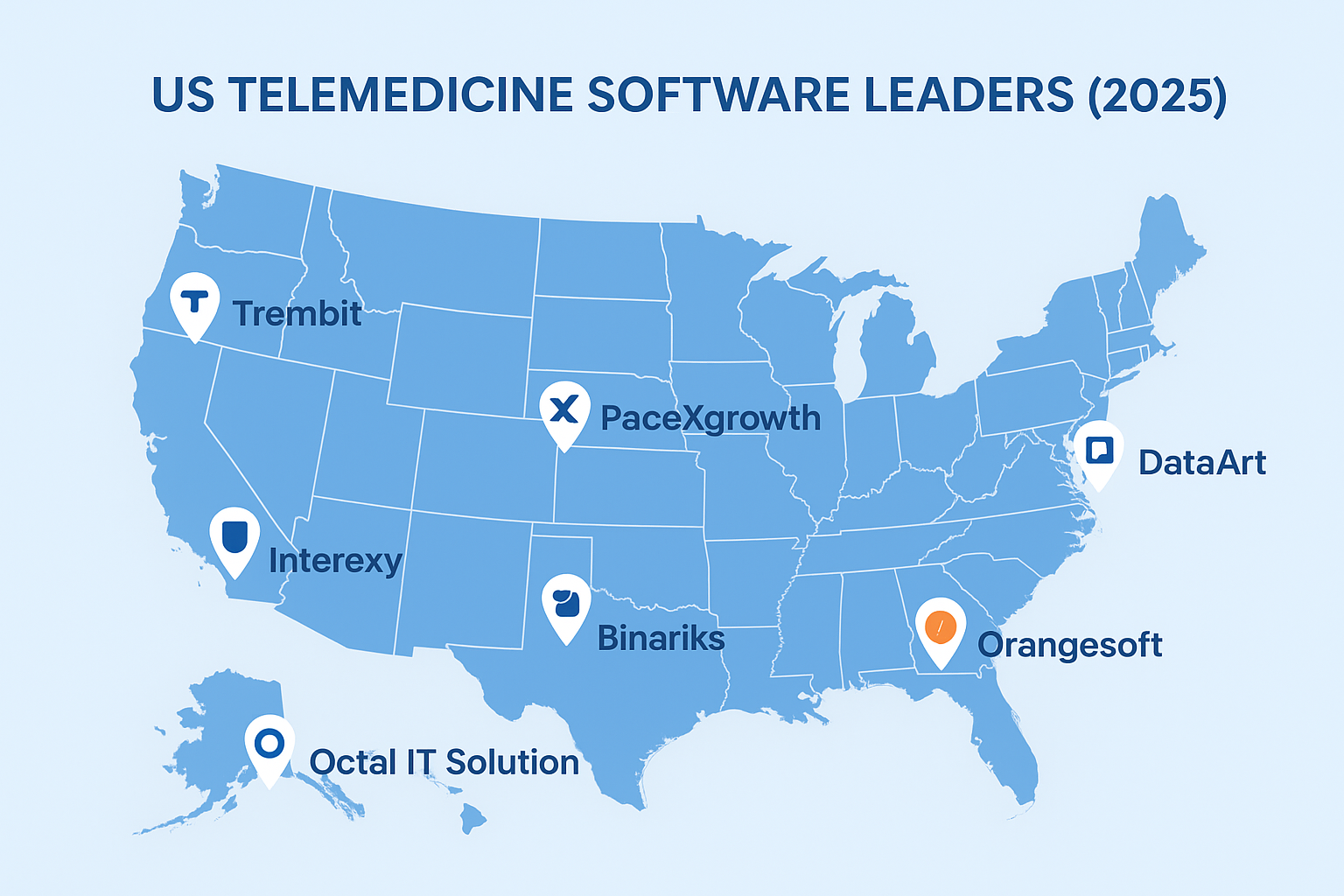
Top US Leaders in Telemedicine Software Development (2025)
Below is the curated list of companies shaping the future of telemedicine.
1. Trembit – Setting Standards in AI-Driven Telemedicine
Trembit leads the list as a US telemedicine software development partner with proven expertise in video streaming, AI, and real-time communication technologies. Their solutions are designed for scalability, ensuring smooth performance even under high patient loads.
Key strengths:
- Deep experience in video streaming & WebRTC
- AI-powered features: speech-to-text diagnostics, video analysis, adaptive streaming
- Strong compliance: HIPAA-ready, ISO standards
- Tailored solutions for clinics, hospitals, and health-tech startups
Trembit is ideal for healthcare providers seeking next-gen telemedicine solutions that integrate AI and deliver reliable, high-quality video experiences.
2. PaceXgrowth – Secure and Compliant Platforms
PaceXgrowth specializes in secure and compliant telehealth platforms, designed specifically for US-based clinics, hospitals, and startups.
Why they stand out:
- Strong HIPAA compliance focus
- Tailored solutions for various healthcare settings
- Emphasis on data protection and encryption
3. ScienceSoft – Global Reach with Healthcare IT Expertise
ScienceSoft is a well-known global software development leader with extensive healthcare IT expertise.
Highlights:
- HIPAA-compliant telemedicine solutions
- AI-powered diagnostics and decision support systems
- 30+ years of software development experience
4. Kanda Software (Newton, MA) – AI and Compliance Driven
With roots in Massachusetts, Kanda Software is a seasoned player in healthcare development.
Key features:
- AI-enabled telemedicine applications
- HIPAA and FDA regulatory compliance
- Strong background in complex healthcare integrations
5. Orangesoft – AI, IoMT, and Secure Platforms
Orangesoft, with US presence, focuses on creating innovative telemedicine solutions that integrate the Internet of Medical Things (IoMT).
Strengths:
- AI and IoMT-based features
- Patient-centric designs
- High compliance with healthcare standards
6. Binariks – Quality and Security at Scale
Binariks has US-based offices and is ISO-certified, which makes them a trusted choice for quality and security.
Specialties:
- Custom telehealth applications with AI integration
- Scalable architectures
- ISO-certified processes
7. Interexy – Full-Cycle Regulatory Expertise
Interexy positions itself as a full-cycle development partner with deep regulatory knowledge.
Highlights:
- HIPAA and FDA compliance expertise
- US-based telemedicine projects
- End-to-end app development
8. Damco Solutions – Client-Trusted Telemedicine Apps
Damco Solutions is known for its strong reputation among US healthcare clients.
Focus areas:
- Telemedicine app development
- Longstanding positive client reviews
- Cost-effective solutions
9. Octal IT Solution – Healthcare and Telemedicine Expertise
Octal IT Solution is a US-headquartered company that builds robust healthcare applications.
Differentiators:
- Proven telemedicine development portfolio
- Integration with healthcare management systems
- Focus on mobile-first design
10. DataArt – Scalable Integrations for Healthcare
DataArt is a trusted name for large-scale healthcare IT projects.
Strengths:
- Complex integrations with existing systems
- Cloud-ready telemedicine applications
- Long-term enterprise partnerships
11. Mindbowser Global – Usability-First Development
Mindbowser emphasizes user-friendly telemedicine apps while maintaining compliance.
Highlights:
- Strong HIPAA compliance record
- UX/UI focus for better patient engagement
- AI-powered telehealth features
Comparison Table: US Telemedicine Software Leaders (2025)
| Company | Key Strengths | Compliance Focus | Ideal For |
| Trembit | AI, video streaming, WebRTC expertise | HIPAA, ISO | Next-gen telemedicine, real-time apps |
| PaceXgrowth | Secure, compliant telehealth platforms | HIPAA | Clinics & hospitals needing compliance |
| ScienceSoft | AI diagnostics, global expertise | HIPAA | Large healthcare systems & startups |
| Kanda Software | AI-enabled, FDA-ready | HIPAA, FDA | AI-heavy telemedicine projects |
| Orangesoft | AI, IoMT, patient-centric | HIPAA | Startups & IoMT-driven platforms |
| Binariks | ISO-certified, AI telehealth apps | ISO, HIPAA | Enterprises prioritizing quality & scale |
| Interexy | Full-cycle, regulatory expertise | HIPAA, FDA | Compliance-first development |
| Damco Solutions | Strong client reviews, cost-effective | HIPAA | SMB healthcare providers |
| Octal IT Solution | Robust healthcare apps | HIPAA | Mobile-first healthcare platforms |
| DataArt | Scalable, integration-heavy | HIPAA | Enterprise-level healthcare IT |
| Mindbowser Global | Usability + HIPAA | HIPAA | Patient-centric, easy-to-use platforms |
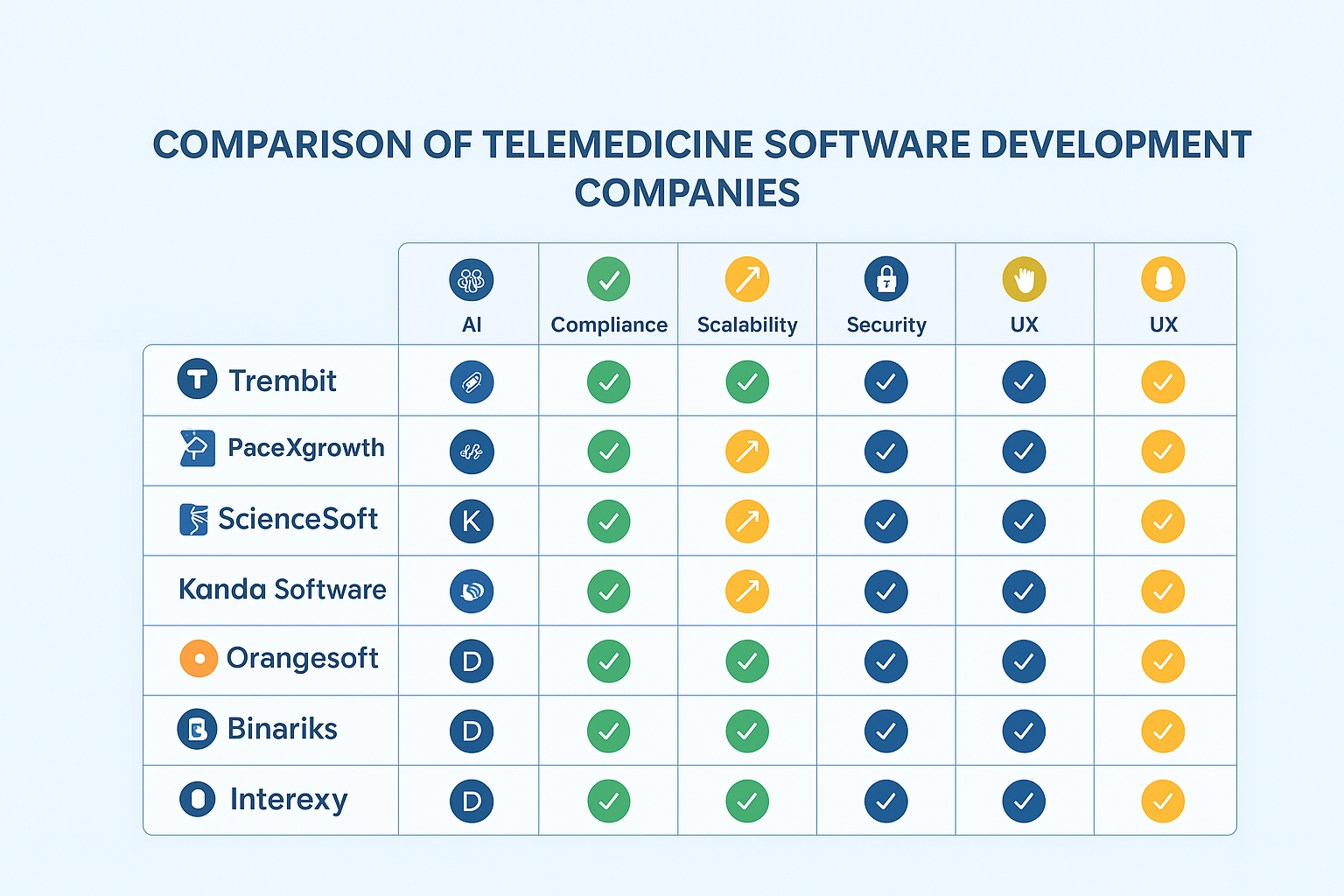
How to Choose the Right Partner in 2025
Selecting the right telemedicine development partner is one of the most critical strategic decisions healthcare providers, startups, and hospitals can make. Beyond the coding expertise, a strong partner brings compliance readiness, healthcare domain knowledge, and an innovation-first approach.
Here are the key dimensions to consider in 2025:
1. Compliance & Certifications
Healthcare software must comply with strict US and international regulations. Ask questions like:
- Does the company have HIPAA compliance expertise?
- Are they familiar with FDA software-as-a-medical-device (SaMD) standards?
- Do they hold ISO certifications for data security and quality management?
Tip: Don’t rely on promises alone — request case studies or documentation.
2. Domain Expertise
A generalist IT vendor may not understand the complexities of telehealth. Look for:
- Past healthcare IT projects (not just fintech, retail, or general SaaS)
- Experience with EHR/EMR integrations
- Understanding of clinical workflows and patient experience
Tip: A partner with proven healthcare knowledge reduces risks and accelerates development.
3. Scalability & Performance
Telemedicine platforms must scale as patient demand grows. Evaluate:
- Cloud-native architectures (AWS, Azure, GCP)
- Load testing results under peak usage
- Support for video streaming at scale
Tip: If you expect rapid growth, prioritize a partner who builds for scale from day one.
4. Innovation & AI Capabilities
The future of telemedicine is AI-driven. Look for:
- AI-powered diagnostics (speech-to-text, medical imaging, decision support)
- Integration with IoMT devices (wearables, connected medical equipment)
- Adaptive video streaming for reliable remote consultations
Tip: Providers who fail to integrate AI risk falling behind competitors.
5. Security & Data Protection
Patient trust depends on secure systems. Confirm:
- Use of end-to-end encryption in video calls
- Regular penetration testing and audits
- Data residency policies that comply with US healthcare laws
Tip: Ask for their incident response plan to understand how they handle breaches.
6. Client Reviews & References
Strong references validate a company’s expertise. Check:
- Verified reviews (Clutch, GoodFirms, G2)
- Testimonials from healthcare providers
- Case studies showcasing real-world impact
Tip: A proven track record is worth more than theoretical expertise.
Decision Checklist for 2025
When shortlisting vendors, healthcare organizations should ask themselves:
- ✅ Is the company compliance-ready?
- ✅ Do they have real healthcare experience?
- ✅ Can they scale to meet future demand?
- ✅ Are they innovative with AI & IoMT integrations?
- ✅ Do they have proven security measures?
- ✅ Can they show successful healthcare case studies?
Choosing the right partner means not just launching a product but building a future-proof telemedicine ecosystem.
Final Thoughts
In 2025, telemedicine software development in the US is driven by security, AI integration, compliance, and usability. While many companies deliver strong solutions, Trembit stands out as a leader in AI-driven telemedicine and real-time video expertise — making it a trusted partner for healthcare organizations ready to scale.
For providers, startups, and hospitals, the choice of development partner can define not just project success but also patient trust and long-term growth.